THE ARTIST
Kevin Cannoot
"An artistic fusion of spirit, science, and perpetual curiosity."
There is a question that has followed Kevin Cannoot his entire life, showing up in different forms depending on the decade: what is this all for? Not in a despairing way — in a genuinely curious one. The kind of curiosity that leads a kid raised between an Episcopalian mother and a lapsed Catholic father to spend his college years reading Buddhist philosophy, and later to board a plane to India.
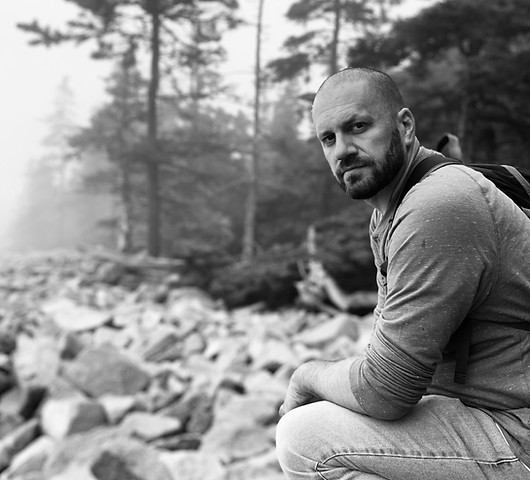
Kevin Cannoot · Columbus, OH
It was there, in 2007, that the question found a visual language. On a pilgrimage with his yoga instructor — herself a student of the late master teacher and author Harish Johari — Kevin was introduced to the practice of creating yantras: ancient sacred geometric diagrams used as objects of meditation. Sitting in Johari's home, he encountered something that felt equally ancient and precise. A yantra is not decoration. It is a map — a diagram of invisible forces rendered visible. It is, depending on who is looking, a devotional object, a mathematical system, or a cosmological schematic. Often all three at once.
That last part stuck.
Kevin has spent the years since exploring what happens at the intersection of sacred imagery and scientific inquiry — not to resolve the tension between them, but to inhabit it. The same instinct that draws him to the iconography of Shirdi Sai Baba and the Blessed Virgin also draws him to cosmology, to the strange behavior of matter at the Planck scale, to the way physicists describe the fabric of spacetime in terms that mystics have been using for centuries. The language is different. The questions are the same.
His work — made primarily with spray paint and stencil but open to whatever medium the image demands — draws from Hindu and Vedic tradition, Christian mysticism, sacred geometry, and the visual vocabulary of pop culture. Saints, deities, yantras, icons. Each piece holds multiple readings simultaneously: spiritual, scientific, aesthetic, mythic. What it means depends entirely on who is looking.
That is not an accident. It is the whole point.